

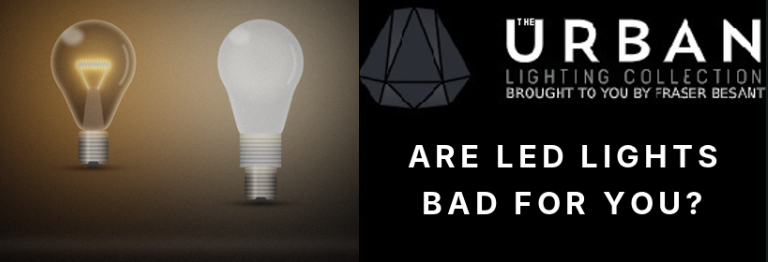
There is a lot of noise on the internet at the moment, claiming that LEDs are affecting our health, not just because of the blue light that they are emitting, but also because of the ‘lack’ of beneficial infrared light that it isn't producing.
The argument can make some sense logically, as it is discussing the idea that humans have evolved under natural sunlight - which contained a broad spectrum of light (380-700nm), and comparing it to how humans are living currently, which, especially in winter months, involves people spending a large proportion of their day under LED lights - and how that in turn affects how our cells produce energy, as well as the lack of the beneficial rays.
Whilst this can begin to make some sense, and it would be easy to deduct from this thinking that LED are inherently bad - this does appear to be a typical case of scientific curiosity being heavily distorted into a sensationalist health panic. We have seen similar trends in the past, like with vaccinations for example.
The reality is, however, that LEDs do emit red light – it’s just the way that they produce it is different to older incandescent bulbs. These old school bulbs worked by having a piece of hot metal (typically tungsten filament) glow to emit light, one that is heavy in red and infrared wavelengths.
LEDs on the other hand, are typically a blue LED chip coated with a phosphor material. The blue light excites the phosphor which converts a portion of that light into green, yellow and red wavelengths.
Now, whilst standard cool-white LEDs like this do spike more heavily in the blue range, and have a lower amount of the red/infrared range compared to incandescent bulbs or even the sun – they still emit light across the visible red spectrum. And with warm white LEDs being more popular overall that cool white, these use extra-red shifted phosphors to fill out the spectrum even further.
There is absolutely no scientific evidence to suggest that LEDs are harmful to one’s health. The argument is claiming essentially that LEDs lacking certain quantities of red/infrared light is toxic, especially when compared to when using non-LED bulbs. We have seen no issues of health in over 100 years using bulbs, and the main point for this, is that the old standard bulbs we use at home were never designed for photo biomodulation (red-light therapy), and are a tool for being able to see and light spaces properly. They were in no way designed to be, or in practise used for getting the properties we need and get from the sun.
So, in this sense, no – LEDs are not killing you, harming you, or are anything close to asbestos as people like Steve McCauley (a leadership coach/ journalist, not scientist) is writing about in The European.
Blue light does affect our Circadian Rhythm, which may be the only real point to consider regarding excess of blue wavelengths. High intensity, blue rich cool white light can trick your brain into thinking it’s day time, releasing serotonin and suppressing melatonin release. And on the flip side, warm to extra warm white, richer in the red wavelength light – does the opposite by protecting melatonin suppression. Knowing this can allow you to light your spaces accordingly to what you want the feel of the room to be, and whether you want it to help you be productive, and awake – or more relaxed.
This isn’t inherently a flaw to all LEDs, it’s simply a design issue – one that can be greatly improved on. This is why there has been a big shift towards ‘human-centric’ lighting technology. With the following being incredible advancements in the lighting world:
- Dim-to-warm
This is the most directly useful one for circadian health. As the light is dimmed, its colour temperature drops from around 2700K to 1800-2000K, mimicking incandescent bulbs or candlelight. Warmer, dimmer light in the evening contains much less short-wavelength (blue) light, which is the part that most strongly suppresses melatonin. It’s ideal for living rooms, bedrooms and wind-down hours, and it works well in LED tape under cabinets or behind furniture for low-level evening lighting.
- High CRI
CRI measures how accurately a light shows colours compared to natural light, on a scale up to 100. It doesn’t directly control circadian effects, but it indirectly helps. High CRI LEDs (90+, ideally with a strong R9 red value) use better phosphors and produce a fuller, smoother spectrum. That means less harsh blue spike, more natural-feeling light, and warmer light that doesn’t look dull or greenish. Cheap low-CRI LEDs often have a pronounced blue peak with gaps elsewhere, which is the type that tends to feel harsh and disrupt sleep more.
- CCT
CCT is a great mix of all the things you need to alter your space to fit the time, or situation. Is stands for Correlated Colour Temperature. It allows you to change the brightness (lumen output) separate to being able to change the colour temperature as well – which can go from daylight (6500k) all the way to warm white (2700k). This is great for general spaces where you may want brighter more productive light at times, as well as much more relaxing warm colours in the evenings.
You can find various types of this technologies in LED tape on our website:
Or please feel free to come in and chat with us in Bristol:
33 Zetland Road, Redland, Bristol, BS6 7AH
We look forward to seeing you!
Ablectrics Team


