

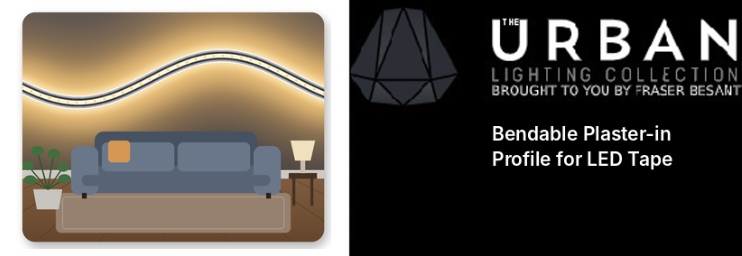
Curves, Coves and Clean Lines: Lighting Curved Spaces with Bendable Profile
Straight lines of light are easy. The harder part is lighting a curved wall, a rounded bulkhead or an arched alcove without kinks, gaps or visible joins. Bendable profile is designed for exactly that.
So, what is it?
It’s a bendable aluminium channel that holds your LED tape. You fit it into the wall or ceiling, plaster over the edges, and it ends up flush with the surface. Once it’s painted, all you see is a clean line of light, with no visible strip, fixings or channel.
The “bendable” part means it can follow a curve instead of fighting it. It comes in 2.5m lengths, with a silver finish, and takes LED tape up to 14mm wide. For a soft, even glow with no visible LED dots, there’s a separate opal silicone diffuser that clips over the tape.
The numbers, simplified:
- Width: 57.3mm. This is the wide flange that gets plastered over, which gives you that seamless finish.
- Internal width: 14.8mm. This is the space for your tape, which is why we say it suits 14mm tape.
- Depth: 18.4mm. That’s how deep the channel sits in the plaster or plasterboard.
- Material: Aluminium, which also helps draw heat away from the tape.
Why plaster-in?
Most LED profiles are surface-mounted, so they sit on the wall or ceiling and you can see them. A plaster-in profile is built into the surface itself. That’s why you see it in hotels, restaurants and modern homes, where the light looks like part of the building rather than something added afterwards.
Where it works well
Living rooms and bedrooms. Run a soft line of light around a curved ceiling edge or a feature wall. It gives you gentle, relaxing lighting without a bulky light fitting.
Kitchens. Use it in a ceiling recess or bulkhead for even background light that fills the room without harsh shadows.
Hallways and stairwells. A continuous line of light guides you along, and it’s much more forgiving than spotlights when you’re moving through a space.
Bathrooms. Glare-free light suits a bathroom. Bear in mind the profile holds the tape but doesn’t make it waterproof, so choose tape and a power supply with the right IP rating for the zone.
Shops, bars, restaurants and offices. Curved reception desks, rounded ceiling features and feature walls all look better with a continuous line of light and no joins.
Tips for a good result
- Plan the curve first. Bendable doesn’t mean infinitely bendable. Very tight curves can kink the profile, so check the minimum bend radius on the datasheet [add minimum bend radius if you have it].
- Check your tape width. Anything up to 14mm fits. Wider tape won’t sit flat in the channel.
- Don’t forget the diffuser. It’s sold separately, so add it to your order. It’s what turns a row of dots into a smooth line of light.
- Bend before you fix. Shape the profile to the curve first, then secure it, then plaster. Trying to bend it after it’s fixed leads to kinks.
- Test the light before plastering. Pop the tape in, switch it on and check it looks right. It’s much easier to fix a problem before the plaster goes on.
- Plan power access. Decide where the driver and cables will go, and leave an accessible spot for future servicing.
Is it a DIY job?
If you’re comfortable with plastering, parts of it are doable. But the electrical connection should always be done by a qualified electrician, and a good plasterer makes a real difference to the finish. Plastering a profile cleanly is what makes the whole thing look professional.
The bottom line
If your space has curves, or you simply want light that looks built-in rather than stuck on, the JXW17-FL-PROFILE is an easy way to get a smooth, high-end look. Plan the layout, match your tape, add the diffuser, and let the plaster do the hiding.
Come see us
We're based in Bristol, at Ablectrics, 33 Zetland Road, BS6 7AH.
We would love to see you in store, or call us on 0117 942 5355 with any questions or queries you may have. You can also email us at sales@ablectrics.com
Find out more information here on our website:


